Milestone #3: Five Forces Determine How Attractive Your Business Field Really Is

Season 1 – Strategic Business Fundamentals
Hardly any question consumes as much energy in companies as the question of how to become better in the market. Another question is given surprisingly little thought: In which market is being better actually worth it?
Yet the choice of business field is the decision that frames all subsequent decisions. It determines which opportunities and risks a company exposes itself to and where it ties up capital, capabilities and management attention. Milestone #1 named the three drivers of business success; Milestone #2 addressed the constitutive fundamental decisions that make a company viable in terms of value-creation quality. Milestone #3 explores the first of these, the choice of business field: Which forces determine how much value-creation potential a business field tends to offer a company?
The Milestone
Milestone #3: 5 Key Factors as Determinants of Business Activity
The decision on a company's business field defines the content of its business activity and is therefore of paramount importance. It requires a deep understanding of the current and expected opportunities and risks of the market. On this basis, it must be determined whether the company, with its capabilities, can sustainably achieve competitive superiority in differentiation, customer value and cost efficiency. A systematic market and competitive analysis of the intended business field is therefore essential.
To this end, Porter proposes the Five Forces, an analytical model that addresses the five most important business-critical determinants of the immediate market:
Competitive rivalry
Threat of new entrants
Threat of substitute products
Bargaining power of suppliers
Bargaining power of customers
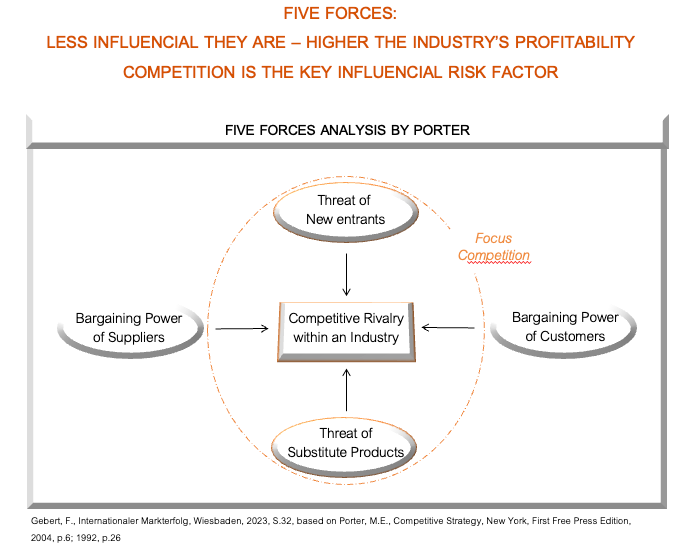
The Graphic: Competition at the Center
The Five Forces diagram shows four forces acting on the existing competition within an industry: new entrants coming from above, substitute products exerting influence from below, suppliers acting from the left and customers from the right. Competitive rivalry sits at the center – and the diagram's headline sums up the core message:
The less the five forces exert their influence, the higher an industry's profitability tends to be. Competition is the decisive risk factor.
Two statements from the milestone deserve particular attention:
Assessing the forces as a whole gives an indicative impression of the average value-creation potential of a business field: the stronger the combined influence of the forces, the lower the level of profitability – and vice versa.
The most powerful influencing factor determines industry profitability. What matters is therefore not the average of the five forces, but which single force shapes the industry most strongly.
The analysis thus delivers more than an industry description. It also makes it possible to assess how capable one's own company is of succeeding within this field of forces.
The Five Forces – and What They Do in Practice
In the book Internationaler Markterfolg (International Market Success), Frank Gebert describes each of the five forces with its drivers and an example from his own experience. These examples make the mechanism tangible.
1. Bargaining Power of Customers
Customers influence value creation through their expectations regarding price, quality, product range, service or delivery speed. Their position is all the stronger the larger the supply of equivalent products, the lower the barriers to switching to alternatives and the greater the purchasing volume of an individual customer.
In practice – German kitchen furniture industry: Purchasing associations represent thousands of retailers and hold negotiating authority over more than 70 percent of trade volume. This concentrated buying power is matched on the manufacturers' side by overcapacity and largely interchangeable offerings. The result: retail dominance over prices and purchasing, even beyond the limits of economic viability.
2. Bargaining Power of Suppliers
Suppliers affect value creation when they can impose prices, payment terms, standards or the pace of innovation in their own favor. They succeed all the more easily the more unique their market position, the greater the demand relative to supply capacity and the higher the hurdles to switching to alternative suppliers.
In practice – furniture industry: A Japanese manufacturer of coating foils offers unique color and surface quality thanks to its production technology. This unique position allows it to enforce top prices and the conditions that are optimal for itself. For manufacturers, this means high material costs and reduced value creation. If they raise prices to increase margins, they risk sales and market share, depending on the competitive situation. Even more dangerous is the dependence on this supplier: as a monopoly provider, it dictates the terms, which the furniture manufacturer has to accept because product lines in its range are built on the uniqueness of the coating foils. Once launched on the market, these cannot be withdrawn at short notice without annoying or harming the company's retailers and end customers. The consequence: however much the conditions burden value creation, the manufacturer has to accept them.
3. Threat of New Entrants
New providers want to gain market share and offer greater customer value to do so, e.g. lower prices, better service, innovations. Established players have to follow suit – at the expense of margin and profitability. The threat is all the greater the weaker the technology, cost or brand advantages of the incumbents, the lower customer loyalty and the lower the switching costs and barriers to entry.
In practice – mobile phone and smartphone industry (2009–2019): Within a few years, the dominant market leader Nokia was displaced by the newcomers Apple and Samsung through their technological lead, user value and brand strength. Nokia had to accept a loss of more than 90 percent of its unit sales and price reductions of over 30 percent. From 2015 onwards, Chinese manufacturers such as Huawei, Xiaomi and Oppo gained market share from Samsung and Apple with equivalent products at lower prices. In all these examples, the established market leaders were unable to defend themselves against the new competitors through differentiation and customer value.
4. Threat of Substitute Products
Substitutes offer customers an alternative solution with greater value for comparable needs. They threaten not only individual providers but the existing market as a whole – up to the point of requiring changes to business models, products and technologies. Their impact is all the more far-reaching the greater the technological leap, the greater the added value and the more attractive the price-performance ratio.
In practice – from analog to digital photography: For around a century, Kodak dominated the private home photography market for analog 35 mm cameras. Digital compact cameras and smartphones replaced the existing competition. Kodak needed a new business and value-creation model – the existing one had become completely obsolete through technology-driven substitution. If a company wants to enter a market threatened by substitution, it must be able to differentiate itself from future competitors, provide value to customers and have a competitive cost structure.
5. Competitive Rivalry
The battle for the customer is a constant, reciprocal process: existing competition is changed by the other four forces and at the same time acts back on them. Intensity is driven in particular by a high number of providers with comparable market shares, overcapacity, declining demand, low differentiation, hardly defensible competitive advantages and low barriers to market entry.
In practice – German kitchen furniture industry (since 2000): Around 100 small and medium-sized manufacturers, roughly 35 percent overcapacity, interchangeable products, declining demand and dominant purchasing cooperatives led to ruinous price competition. Decisive for survival were a superior cost structure, retailer-friendly terms and conditions and attractively priced mainstream products.
What the Five Examples Show Together
What stands out is that the same pattern always emerges at the core: in all five scenarios, what ultimately decides is differentiation from the competition, value for customers and the performance of the company's entire transformation process – in other words, cost efficiency that is superior to the competition.
And the examples show something else: the forces do not act in isolation. The buying power of the purchasing associations intensifies the price war among manufacturers. New entrants increase competitive rivalry. Substitutes can shift the entire field. Anyone who looks at only one force underestimates the overall picture.
Market Attractiveness Is Only Half the Decision
Even a structurally attractive business field does not guarantee success. The milestone therefore calls for a comparison with one's own capabilities: can the company sustainably build competitive superiority within the intended field of forces? Three questions are central to this:
Competitive differentiation: What sets us apart from the competition?
Customer value: What relevant added value does the customer recognize?
Cost efficiency: How efficient is our value creation compared with the competition?
The book adds four internal prerequisites for success, which must be weighed against the externally imposed requirements: entrepreneurial competence (vision, leadership ability, financial strength, networks), management competence, customer-relevant competitive differentiation and a competitive value-creation structure. Only by matching the requirements of the market against these capabilities is there a basis for a rational decision on entering a business field.
The Limits of the Model
In all honesty: the Five Forces do not provide a formula. Their limits lie in realistically quantifying the effects on profitability, in factoring in the mutual reactions of the forces and in taking account of factors that matter today, such as political protectionism and digitalization. Nevertheless, these limitations do not detract from the model's practical value, because its logic and systematic approach take you further. It provides a uniform assessment standard with which different business field options can be compared in terms of attractiveness.
A note from practice: in mature markets with a settled competitive structure and often up to three main competitors, price points and success factors are more predictable than in emerging growth markets, where price erosion, innovation dynamics and new entrants are hard to foresee. So what grows fastest is not automatically what is most attractive.
Three Questions for Your Own Business
The forces test: Rate each of the five forces for your business field as low, medium or high. Which single force currently shapes attractiveness and risk most strongly?
The future test: How will this force develop in the coming years – and who in your company is monitoring this systematically?
The fit test: Do your capabilities fit this field of forces? Where do you need to differentiate, create customer value or improve your cost structure?
Conclusion
The Five Forces analysis does not deliver an automatic decision. It creates transparency about where economic leeway arises in a business field, what limits it and which capabilities a company needs to be sustainably successful in it. The stronger the five forces, the lower the level of profitability tends to be. Competition is the central risk factor, and the most powerful force determines the overall picture.
The sequence is decisive: first assess the attractiveness of the business field, then measure your own competitive position against it. Anyone who skips this step may end up optimizing very well in a market that leaves them little room anyway.
Further Reading
You can find all milestones to market success collected at a glance on my homepage:
Each milestone is also available there as a PDF download. In addition, there is a paid self-study course for each milestone, which lets you deepen the content in a structured way and apply it directly to your own business. All milestones published so far can also be downloaded as a bundled self-study course. You can find the self-study courses at www.frankgebert.de/selbstglernkurse-markterfolg.
Milestone #3 at a glance: www.frankgebert.de/news/meilenstein3
The complete content basis is provided by the book „Internationaler Markterfolg – Wachstum im globalen Wettbewerb“ (International Market Success – Growth in Global Competition; Springer Gabler, ISBN 978-3-658-39427-1), available via link.springer.com, Amazon and specialist bookstores. Chapter 3 „Bestimmung des Geschäftsfeldes“ (Determining the Business Field) covers the Five Forces in detail.
Source of the graphic: Gebert, F., Internationaler Markterfolg, Wiesbaden 2023, p. 32, based on Porter, M. E., Competitive Strategy, New York 2004, p. 6; 1992, p. 26.
Prof. Dr. Frank Gebert — www.frankgebert.de


Comments